 kbutler1
TikTok news has quietly become the defining information source of a generation. For millions of young people worldwide, the morning scroll has replaced the morning paper. However, this is not simply a story about a new app gaining popularity. It is a story about a fundamental shift in how an entire generation understands the world and the serious consequences that come with it.
In this article, I take a deep dive into TikTok news and its impact on Gen Z. I explore the data, examine the positives and negatives of social media news, and break down the critical differences between misinformation, disinformation, and malinformation.
How Gen Z Became the TikTok News Generation
To understand TikTok news, you first need to understand Gen Z’s relationship with media. Our generation didn’t grow up with newspapers or evening news. We grew up with smartphones, algorithms, and infinite scroll. So naturally, our news habits look completely different to previous generations.
According to Pew Research (2025), adults aged 18–29 are especially likely to get their news from platforms like TikTok, Instagram, Reddit, and YouTube. Around 43% of that group regularly get news on TikTok, with 41% using YouTube. Even more striking is that 55% of TikTok users now say they regularly get news from the app — up from just 22% in 2020. That’s more than doubled in five years, and it’s still growing. What’s really significant is that 2025 was the first year TikTok overtook both YouTube and Instagram as Gen Z’s top platform for news consumption. That’s a major shift. TikTok news isn’t niche anymore — it’s become mainstream.
A 2026 survey of 1,000 Gen Z adults in the US found that 44% access news daily through social media, with 25% naming TikTok as their main source. On top of that, a 2025 PartnerCentric survey found Gen Z spends an average of three hours per day on TikTok. When the same app is both your main source of news and something you use for hours every day, the line between entertainment and information becomes seriously blurred.
Why Gen Z Trusts TikTok Over Traditional Media
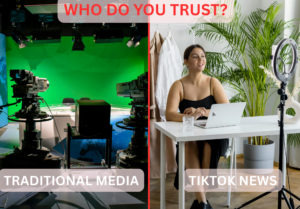
The shift toward TikTok news isn’t accidental — it reflects something deeper: a growing breakdown of trust in traditional institutions, including mainstream media. For Gen Z, trust tends to be relational before it’s institutional. Credibility is built through tone, consistency, transparency, sourcing, and community reputation — not just a masthead. In other words, a creator speaking directly to camera, using plain language, and clearly citing sources can feel more trustworthy than a polished news anchor reading from a teleprompter.
Independent creators are now more popular among Gen Z for news than many major outlets on TikTok. What this audience wants is regular, short-form content that feels organic, not over-produced. A good example is V Spehar, who runs @UnderTheNewsDesk and has built an audience of nearly four million followers through a conversational, accessible style of delivery. A Q2 2025 survey by Sprout Social found that 41% of Gen Z turn to social media first for information, ahead of traditional search engines. At the same time, TikTok’s algorithm curates a personalised “For You” page, tailoring content to individual interests and making news feel immediate and relevant. For a generation that values personalisation so highly, that’s a huge part of the appeal.
The Positives: What TikTok News Gets Right
It would be easy to dismiss TikTok news as shallow or even dangerous. However, that ignores the very real benefits it offers, especially for younger audiences.
Accessibility and Reach: TikTok reaches people who never engaged with traditional media in the first place. It’s free, requires no subscription, and is available to anyone with a smartphone. In that sense, it democratises access to information therefore making news more accessible and encouraging greater civic awareness among younger users.
Speed: TikTok’s immediacy makes it a go-to for breaking news. Whether it’s major global events or hyper-local updates, information spreads quickly. Pew data shows that 55% of TikTok users under 30 encounter breaking news as it happens on the platform.
Diverse Voices: TikTok has opened the door to communities and stories that mainstream media has often overlooked. Grassroots reporters, marginalised voices, and local perspectives can gain traction without traditional editorial gatekeeping.
Format: News delivered through conversation, humour, and storytelling lands differently than a dense broadsheet column. For Gen Z, this isn’t about dumbing things down — it’s simply a more effective way of communicating in a format that matches how they consume information.
The Negatives: The Dark Side of Social Media News
Nevertheless, the risks of TikTok news are just as real and in some cases, quite alarming.
The algorithm isn’t an editor: Unlike a newspaper, where decisions are made around public interest, TikTok’s system is built for engagement. That means emotional, sensational, or outright false content spreads faster than accurate reporting. A misleading clip can hit millions of views before anyone even starts fact-checking it. It becomes quite alarming that a 30 second news clip can become such a dangerous piece of information.
Depth gets lost: A 30-second video can’t carry the same ideas that serious journalism needs. When simplified turns into oversimplified, people end up feeling informed when they’ve only skimmed the surface of something much more complex. Many users will think they know the full story, when in reality, they are only touching the surface.
Echo chambers: TikTok’s algorithm feeds you more of what you already agree with. When you engage enough with a certain viewpoint, your algorithm shows you similar content. It reinforces your beliefs instead of challenging them, therefore narrowing what you actually see.
Gen Z isn’t as immune as it thinks. A global study of 66,000 people by researchers at Cambridge and UBC found Gen Z is actually one of the most susceptible groups to misinformation. It cuts against the idea that being a “digital native” automatically means being media literate. What’s interesting, though, is that Gen Z also reported the lowest confidence in spotting misinformation but were the most aware of that weakness.
Understanding the Information Threat: Mis, Dis, and Malinformation
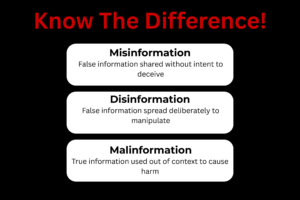
Not all false or harmful information is the same. If you’re going to use TikTok News as your main source of information, you need to be aware of the differences.
Misinformation is false information shared without intent to deceive. It’s usually an honest mistake. Outdated facts, misunderstood data, or creators repeating things they haven’t properly checked are often the main reasons people get caught out. On TikTok, this often comes from oversimplifying complex topics. The problem with this is, the format rewards confidence and clarity, so misinformation can often sound more convincing than the truth.
Disinformation, meanwhile, is more serious. This is false information spread deliberately to mislead or manipulate. This is where social media news becomes genuinely risky. A 2024 study found young voters were regularly exposed to misleading political content on the platform, including AI-generated and fabricated videos of political figures. When that sits alongside real content in a fast-moving feed, it becomes much harder to tell what’s real and what isn’t. When you also consider the fact deepfakes are so prominent and easy to make, news credibility consequences are severe.
Malinformation is the most subtle of the three. It’s technically true information, but used in a misleading way. Usually it’s taken out of context, selectively framed, or edited to push a certain narrative. On TikTok, where context is often stripped back for speed, content like this is what becomes most popular.
The scale of the issue is hard to ignore. Around one in five TikTok videos contains misinformation. The World Economic Forum has even ranked misinformation and disinformation as the biggest global risk for 2025–2026. Eventhough awareness is growing, it’s not enough when the systems shaping what people see are built this way.
The Responsibility Gap: Who Is Accountable?
When something goes wrong in traditional journalism, there are accountability structures, including editors, publishers, regulators, and public scrutiny. With TikTok news, that gap is much wider.
While TikTok has introduced fact-checking measures, including partnerships across over 130 markets, the rise of AI-generated content has made misinformation and propaganda harder to control. At the same time, individual creators hold huge influence with very little responsibility. A single viral video can shape public understanding of a political event, a health crisis, or a social issue, with no editorial oversight, no corrections process, and no real obligation to follow journalistic standards. For Gen Z audiences treating this as news, the stakes are high.
What Responsible TikTok News Consumption Looks Like
The answer isn’t to abandon TikTok as a news source, but to raise the standard of media literacy, especially for Gen Z. Responsible use means treating TikTok as a starting point, not an endpoint, following up stories with full reporting, checking who is behind an account, including their credentials, funding, and biases, and cross-referencing claims instead of taking them at face value. It also means understanding mis, dis, and malinformation, asking not just if something is true but if it tells the full story, and actively seeking opposing views rather than relying on the algorithm. At the same time, pressure on platforms like TikTok is growing, with better labelling, stronger enforcement, and real algorithmic accountability increasingly needed.
Final Thoughts: Eyes Open on the Scroll
TikTok News hasn’t broken journalism, but rather reinvented it. It offers a real opportunity to stay informed but presents serious risks due to oversimplification and manipulation. Our consumption across the year is now a constant flow rather than straight line. We move from a 30 second TikTok clip to an Instagram reel, a Reddit thread to YouTube video, a group chat screenshot, and, sometimes, a full article. This doesn’t make us uniformed, but rather, it means the delivery system changed faster than we expected. We will never stop scrolling, so the question shouldn’t be whether we use it for news, because we will. It should be whether we can do it with open eyes, critical thinking switched on, and, a clear understanding of the difference between a short clip and full story
